Email Segmentation and Personalization: How We Decide Who Gets Which Email

The short version
Segmentation decides who gets an email. Personalization decides what each group sees: the subject line, the lead image, the message and the products. We plan both from a brand’s own customer data, build every version in one design system, and measure the set against the brand’s own recent emails.
In Martin Dingman’s 2026 holiday catalog launch, six audience-specific emails earned 271% more Klaviyo-attributed revenue per delivered email, and a 132% higher unique click rate, than the brand’s seven most recent general consumer emails (October 1 to 22, 2026).
Results as of November 2, 2026, about 9 a.m. Central, cumulative since the October 28 and 29 sends. Revenue appears only as a relative rate. The comparison is observational rather than a controlled test, so audience selection is part of the result.
A brand can have well-segmented flows in Klaviyo and still send its biggest seasonal campaign as one email to the whole list. Martin Dingman, which makes handcrafted leather shoes, belts, wallets and travel goods, mailed its first dedicated holiday catalog this fall, and its own launch email for that catalog walked through the entire gift guide.
This piece explains how we approach email segmentation and personalization: what each one is for, where the audiences come from, what changes from one version to the next, and how to tell whether any of it worked. That holiday launch runs through it as the worked example, with the actual emails and their results.
Segmentation and personalization do different jobs
Segmentation answers who. It divides a list into groups using data the brand already holds: what someone has bought, how recently and how often, which product categories they come back to, and whether they mostly buy for someone else.
Personalization answers what. Once a group exists, the email it receives changes so the products and the reason to buy fit that group. A first-name merge tag is the thinnest version of it. The version we build changes the content itself.
The two only pay off together. Splitting a list into six groups and sending each the same email changes nothing a subscriber can see, and tailored copy sent to the whole list has nobody in particular to talk to.
Start from purchase data, then add persona context
Our starting point is the brand’s customer data, usually Shopify orders and Klaviyo engagement brought together in a data warehouse. Purchase behavior decides which audience a customer belongs to. Persona and demographic context, which is modeled rather than observed, shapes what that audience sees, from the product to the photo to the wording.
In our builds, audiences are assigned in priority order, so each customer lands in one group and nobody receives two versions of the same campaign. We cover the warehouse side in more depth in our write-up of Martin Dingman’s Father’s Day campaign, and the common segment types in eight ecommerce segmentation strategies using your own customer data.
For the holiday launch, purchase history and persona data in Martin Dingman’s warehouse produced six audiences: Heritage Holiday, Refined Leisure, Rediscovery, Everyday Craftsmanship, Holiday Gifting, and Work, Travel & Weekends.
Decide what changes in each version
We plan each version around four levers. The subject line and preview text set the expectation before the email is opened. The lead image tells a reader at a glance whether the email is meant for them. The message gives the reason to buy now, and the product selection decides which two or three items get the space.
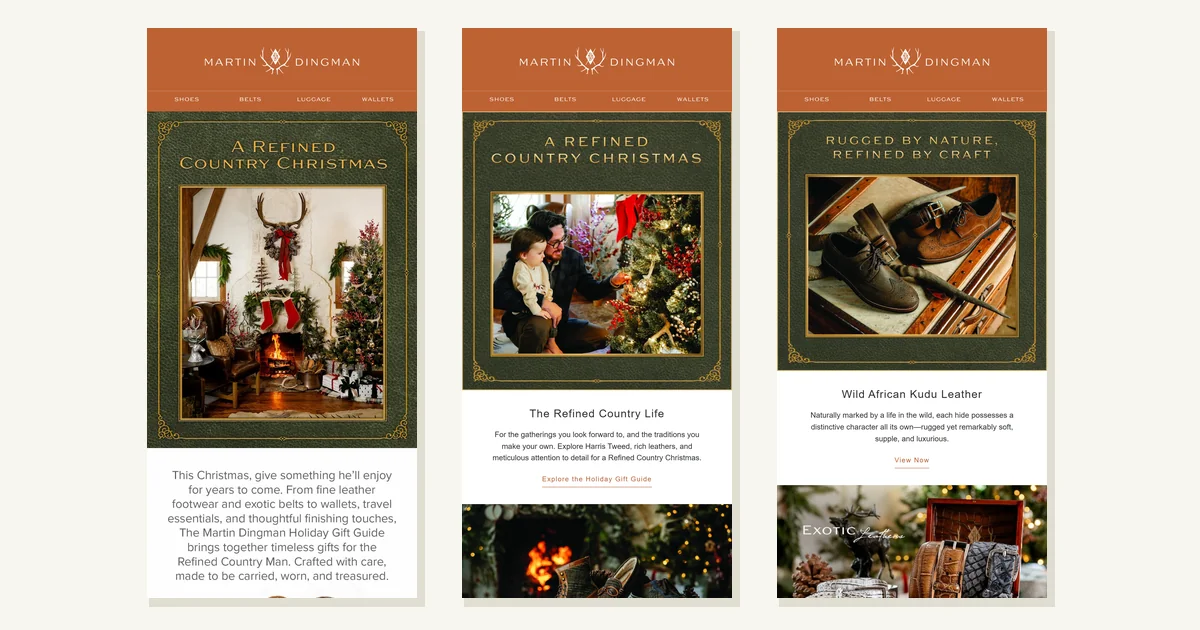
Martin Dingman’s original catalog email is a good picture of the starting point. It opens on a decorated living room under “A Refined Country Christmas,” then walks through the whole gift guide: slippers, the Christmas collection, exotic and Kudu leathers, travel bags and accessories. It suits a broad audience and runs about twice the length of the shortest audience version. Here it is beside Everyday Craftsmanship, the audience version with the highest click rate of the six.
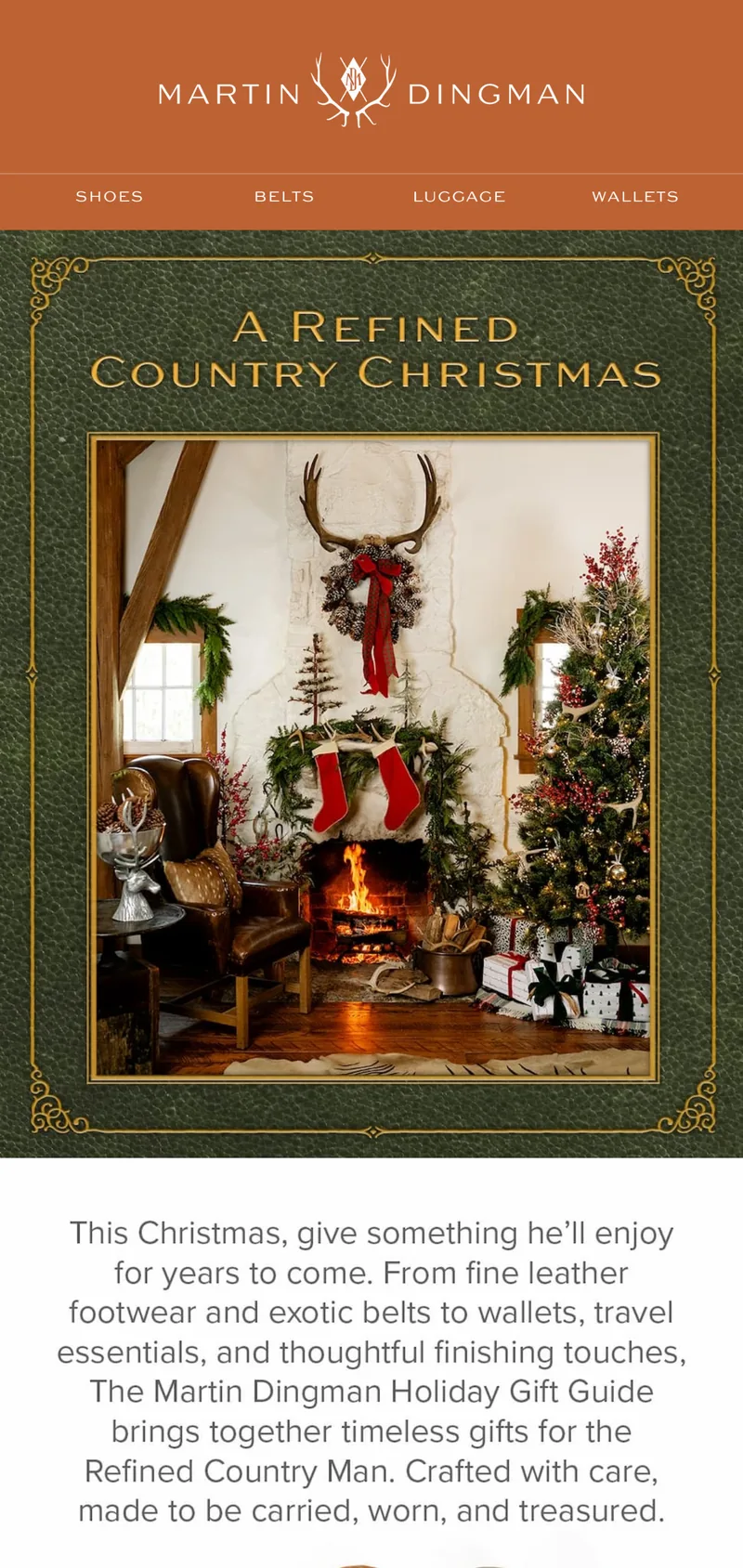
Original catalog emailThe full holiday gift guide, for everyone.
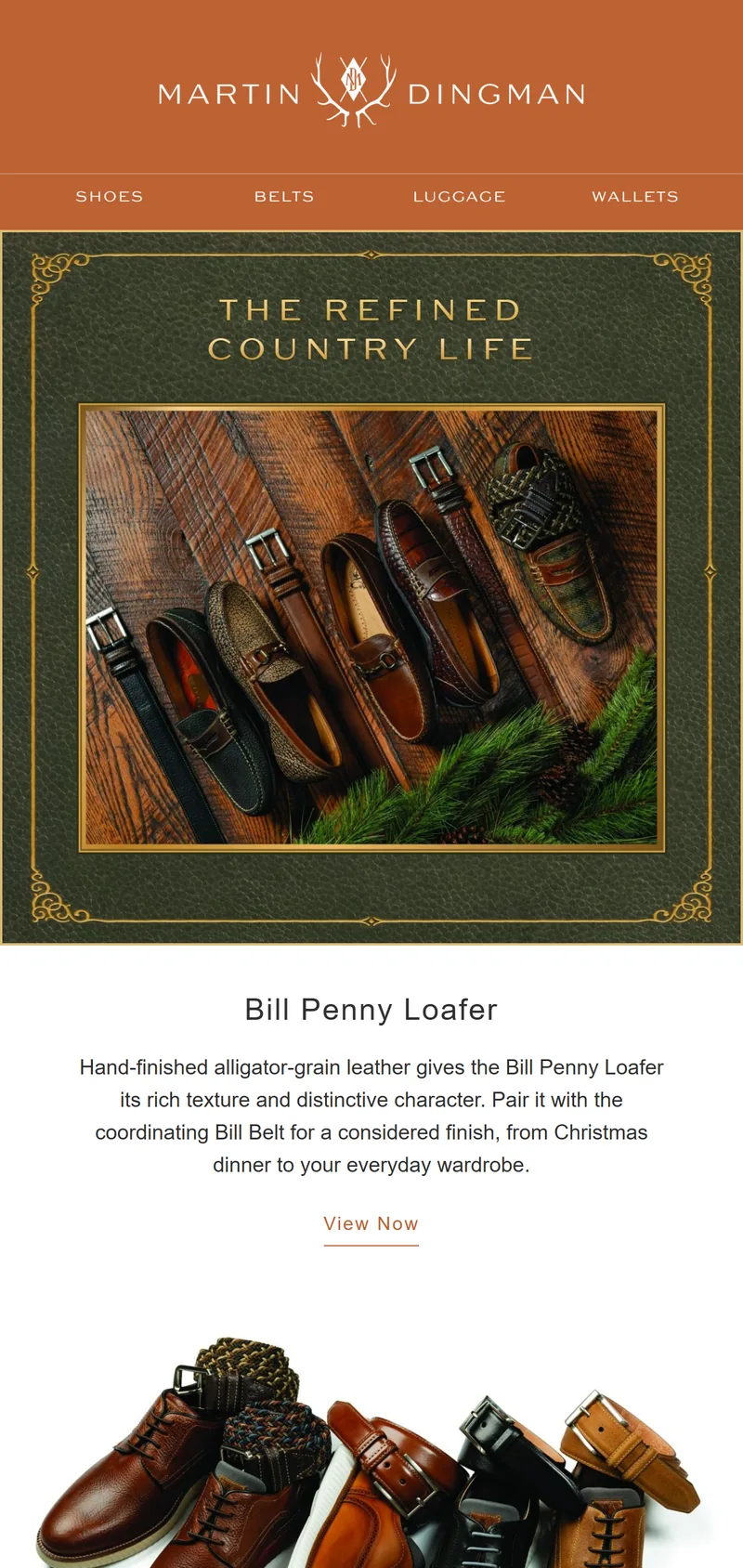
Everyday CraftsmanshipCoordinated shoes and belts for daily wear.
- Subject line“The Perfect Pair,” previewing “The Bill Penny Loafer and Bill Belt, in hand-finished alligator-grain leather.” The product is named before the email opens.
- ImageryThe decorated living room gives way to Bill loafers and matching belts laid out on a wooden table.
- MessageChristmas becomes one occasion among many: the copy pairs the loafer and belt “from Christmas dinner to your everyday wardrobe.”
- Product selectionThree features (the Bill pairing, CountryAire dress shoes and the Cameron sneaker with coordinating belts) replace the full gift guide tour.
Keep one design system across every version
Six versions should still read as one campaign. We build them in LimeLight Studio from the brand’s own design, so the header, frame and typography carry through while the photo, headline and products change. Martin Dingman’s team approved every subject line before the emails were loaded into Klaviyo.
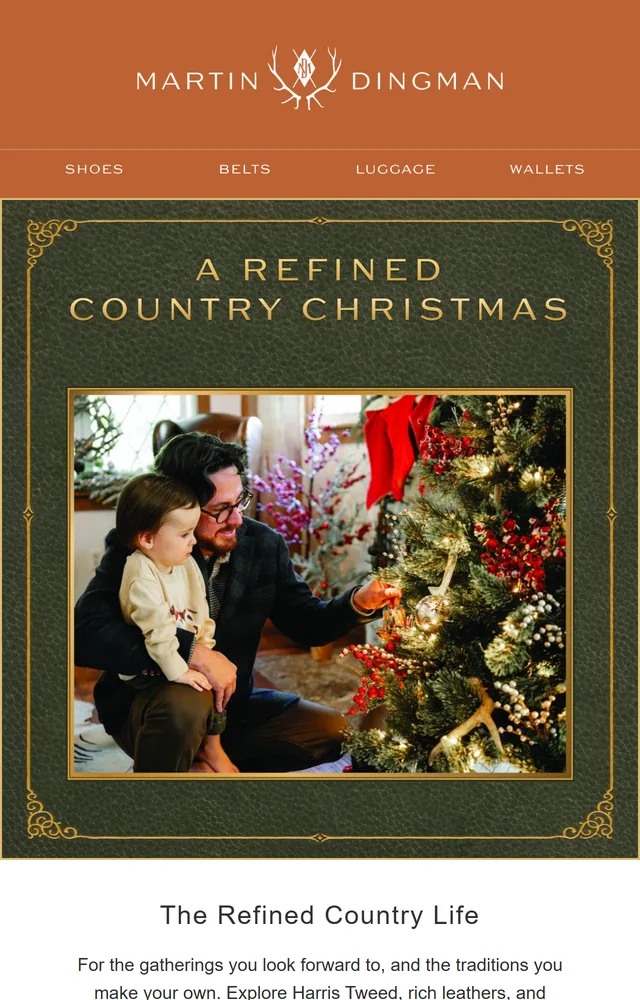
Heritage Holiday“Dressed for the Gathering.” Harris Tweed boots, slippers and the Nicholas Horse Bit. 5,648 delivered.
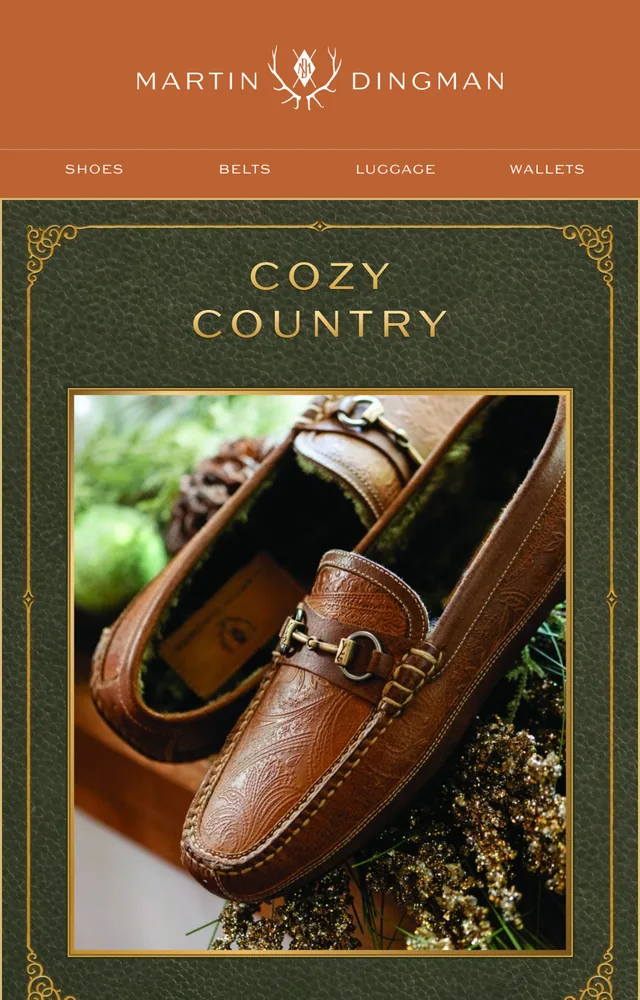
Refined Leisure“Evenings, Well Spent.” Horse bit and smoking slippers, then alpaca socks. 3,869 delivered.
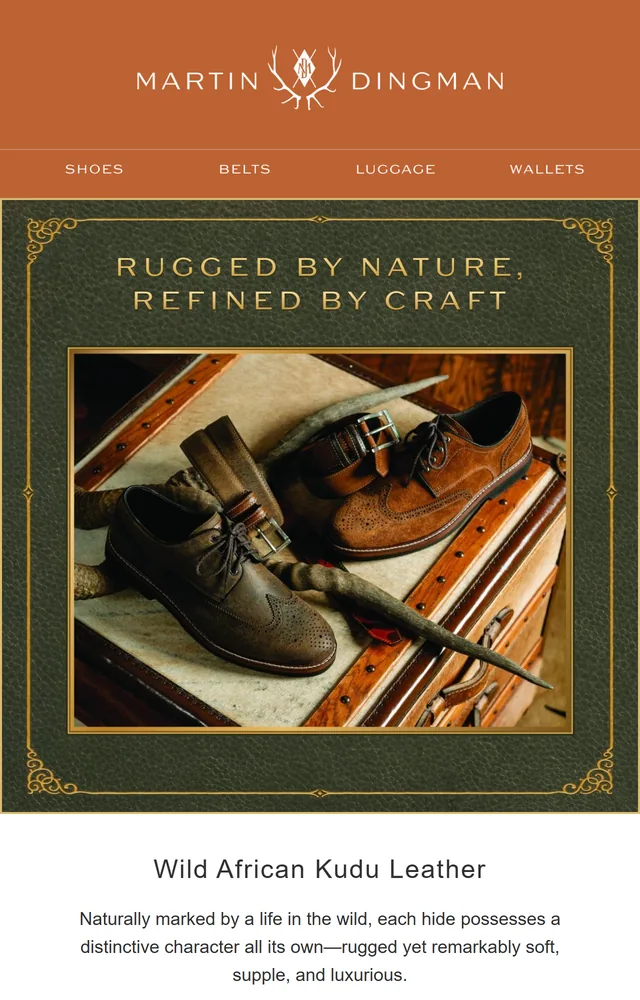
Rediscovery“Marked by the Wild.” Wild African Kudu leather shoes and exotic belts. 25,233 delivered.
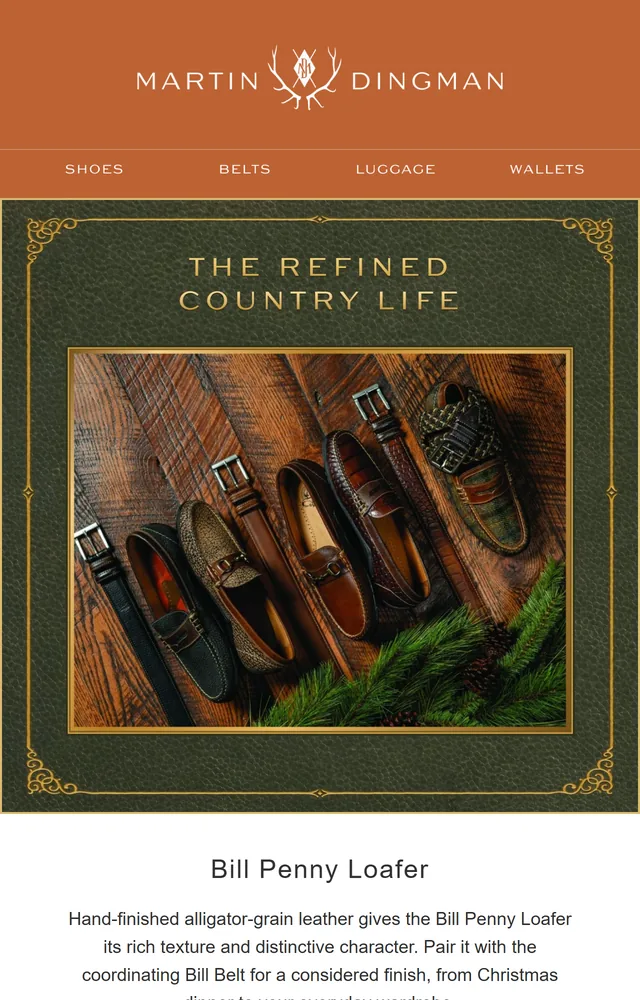
Everyday Craftsmanship“The Perfect Pair.” The Bill Penny Loafer and Bill Belt, CountryAire and the Cameron sneaker. 6,095 delivered.
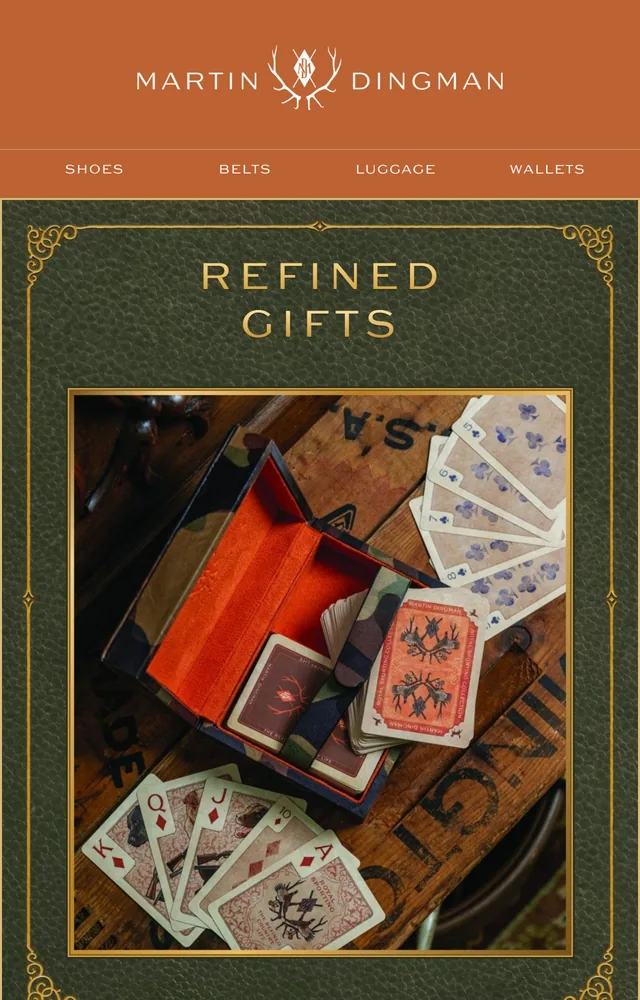
Holiday Gifting“Gifts for the Refined Gentlemen.” Playing cards in a saddle leather case, slippers and wallets. 9,381 delivered.
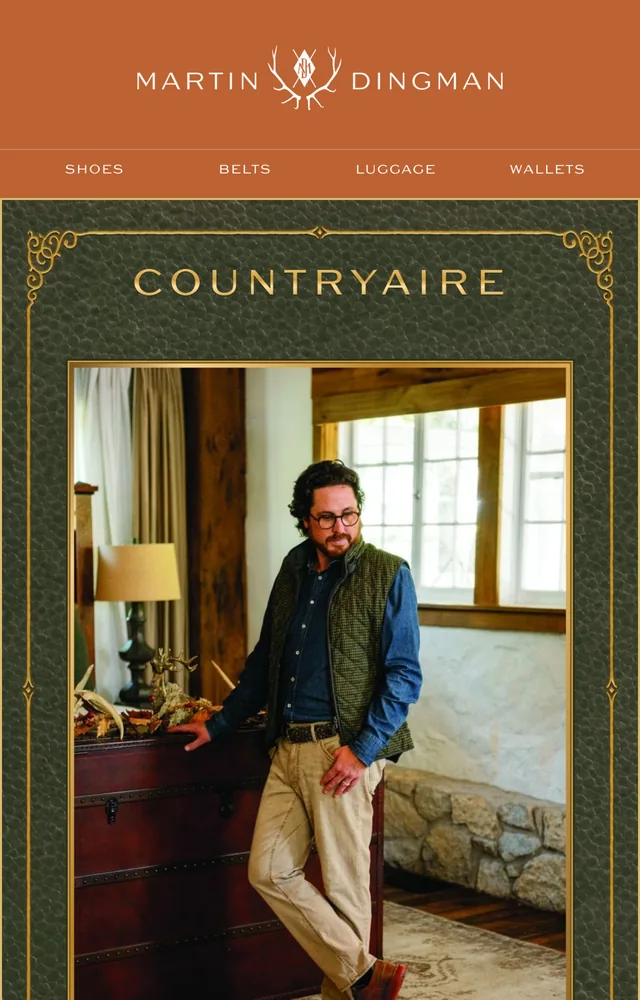
Work, Travel & Weekends“Weekday, Weekend, and Everywhere Between.” CountryAire, the Hudson sneaker and travel bags. 3,038 delivered.
Measure against the brand’s own baseline
We track two measures. Unique click rate is the share of delivered emails whose recipient clicked at least once. Revenue efficiency is Klaviyo-attributed revenue, using Shopify’s Placed Order event, divided by delivered emails. We report it here only as a percentage change, so no dollar figures appear in this article.
Every rate is pooled across sends: total clickers divided by total delivered emails, and the same for revenue, rather than an average of each email’s rate. That way a large send counts for more than a small one. We also keep relative change apart from percentage points, because a 132% lift in click rate can be a move of less than one point.
The six audience emails reached 53,264 inboxes, drew 728 unique clickers and led to 53 attributed purchasers, a 1.37% unique click rate. Here’s how that compares with the brand’s seven most recent general emails.
SIX AUDIENCE EMAILS VS. RECENT GENERAL SENDS
Relative change in revenue per delivered email and unique click rate
Klaviyo reports as of November 2, 2026, about 9 a.m. Central. Delivery-weighted.
Seven recent general sendsOct 1 to 22, 2026
That comparison set is the closest picture of what a normal Martin Dingman email does right now: seven general consumer emails sent between October 1 and 22, 2026, to 1,227,127 delivered inboxes in total. Retailer, lodge-partner and internal sends are left out.
Read each audience on its own
A pooled result can hide a weak segment. Everyday Craftsmanship and Refined Leisure clicked at close to 1.9%, while Work, Travel & Weekends trailed at 0.72%, still above the recent seven-email average but well below the rest of the group.
UNIQUE CLICK RATE BY EMAIL
Every audience email beat the recent average; one fell well short of the rest
Everyday Craftsmanship
Refined Leisure
Rediscovery
Original catalog email (general audience)
Heritage Holiday
Holiday Gifting
Work, Travel & Weekends
Catch-all send (everyone else)
The per-audience view is where the next brief starts. The coordinated-pairs and at-home comfort emails drew the strongest response and the work-and-travel angle the weakest, so that audience is the first one to rethink. The gray bar for the original catalog email matters too: sent to its own general audience, it clicked at 1.35%, almost level with the six audience emails combined.
Where to start with your own list
- Pull the purchase and engagement data you already have and look for groups that buy for different reasons.
- Choose a handful of audiences you can build well, and assign each customer to one of them.
- For each audience, change the subject line, lead image, message and products, and keep the brand’s design system intact.
- Hold out a slice of each audience, then measure pooled rates against your own recent emails with a clear as-of date.
We do this work inside our email and SMS marketing and data-driven personas programs, and you can see the wider partnership in our Martin Dingman case study. If your biggest campaigns still go out as one email, talk with our team about segmenting the next one.