Free AI visibility tool
See your site the way AI sees it.
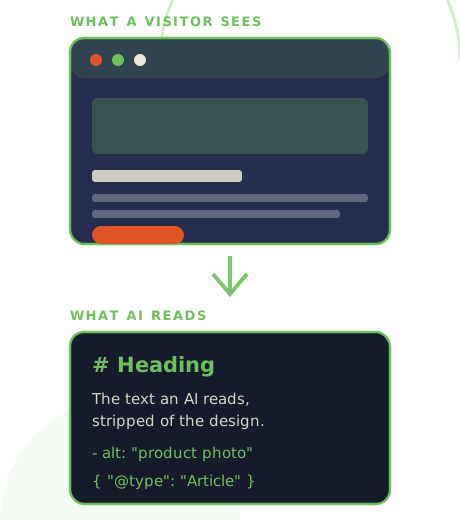
Search engines and AI assistants do not see your page the way a visitor does. They strip away the design, the navigation, and the scripts, and read what is left: the text, your image alt attributes, and your structured data. Paste any public page below and we will show you that stripped-down view, the way an AI extractor reads it.
Extraction report
What the machines can read.
Main content: our extractor
Main content: Readability + Turndown
Readability is the open-source engine behind Firefox's Reader View, and Turndown renders its result as markdown. It is the named, open-standard reference that reader-mode and AI extraction tools are built on, shown next to our own pass so you can see that two real extractors genuinely disagree about what the main content is.
Image alt text
No image alt text was found on this page.
Structured data
No JSON-LD structured data was found on this page.
Validators read these formats too, but AI extractors and large language models typically parse only JSON-LD, the format Google recommends. Schema kept in Microdata or RDFa is easy for them to miss.
Frequently asked questions
What does extractability mean?
Extractability is how easily an automated reader, like a search crawler or an AI assistant, can pull the meaningful content out of your page. That means the main text, the descriptions on your images, and your structured data. A page can look polished to a human visitor and still be hard to extract if the content is locked inside images, scripts, or heavy layout. Extractability is about what survives once the design and navigation are stripped away.
How do AI assistants and search engines actually read a page?
They fetch your HTML, drop the navigation, styling, and scripts, and keep what is left: the text, the alt attributes on your images, and any structured data, which is usually JSON-LD. Large language models work from that stripped-down text, not the designed page you see in a browser. The view this tool shows you is that same machine reading.
Do AI crawlers run JavaScript the way my browser does?
Often they do not. Google can render JavaScript, but it does so in a separate, deferred pass, and many AI crawlers and answer engines read only the raw HTML the server first returns. Content that appears only after JavaScript runs, such as text loaded on scroll or rendered entirely on the client, can be missed. If something matters, make sure it is in the initial HTML.
What do extractors most commonly miss?
The usual gaps are text baked into an image instead of real HTML text, images with no alt attribute (which are invisible to a text reader), content that only loads after a click or scroll, structured data stored in Microdata or RDFa instead of JSON-LD, and a main article so wrapped in widgets and related links that the extractor cannot tell which text is the actual content.
Why does my page show no structured data here when it passes a schema validator?
Schema validators read Microdata and RDFa as well as JSON-LD. Most AI extractors and large language models parse only JSON-LD, the format Google recommends. So schema kept in another format can pass a validator and still be invisible to the AI view. If this tool finds your schema only in other formats, that is worth fixing.
Does image alt text really matter for AI?
Yes. Alt text is the only description of an image that a text-based reader can use, so without it an AI effectively sees nothing where the image is. Good alt text also makes your images usable for people on screen readers, so the same fix serves both audiences.
How do I make my pages more extractable?
Put the important content in real HTML text rather than images. Give every meaningful image clear, descriptive alt text. Add JSON-LD structured data that matches what is actually on the page. Keep the main content in one clear region instead of scattering it across widgets. And check the raw HTML, not just the rendered page, to confirm the content is really there. If you would rather have this monitored and maintained continuously, that is what our agentic SEO program does.
Your next step
Want this working in your favor?
If the AI view of your page is thin, missing alt text, or has no structured data, you are leaving visibility on the table as search shifts to answer engines. Our agentic SEO program keeps all of it healthy, continuously. Let's walk through what AI sees on your site.