Case Study

Adidas Combat Sports

How a Unified, Acquisition-First Strategy More Than Doubled Revenue Year-Over-Year

Services

cromarketingweb

Technologies

Shopify
Meta Ads
Google Ads
Klaviyo

In Q1 2026 vs. Q1 2025, the brand saw:

+138%

revenue growth

+186%

growth in purchases

+180%

growth in new customers

Project Highlights

Acquisition-first paid media strategy
AI creative tested Meta catalog ads
Competitive pricing analysis
PDP variant consolidation
Intent-driven collection pages
Sport-based email segmentation

About the Brand

Adidas Combat Sports is the official distributor of Adidas Combat Sports products in the United States, delivering high-performance equipment and apparel across a wide range of disciplines, including boxing, MMA, taekwondo, karate, Brazilian jiu-jitsu (BJJ), kickboxing, and other martial arts. The catalog covers gloves, shoes, uniforms, apparel, and accessories under the Adidas brand.

While Adidas as a parent brand is globally recognized, the Combat Sports vertical operates as a specialized, lower-awareness ecommerce business with its own direct-to-consumer growth goals.

LimeLight has partnered with Adidas Combat Sports since 2024. Our earliest work centered on replatforming their website from WooCommerce to Shopify and launching their first major BFCM campaign, highlighted here. After the digital foundation was in place, our focus shifted to creating scalable, sustainable growth for a brand where customer loyalty is built around the parent brand.

The Challenge

Scalable growth through acquisition in a competitive market was the challenge.

Adidas Combat Sports is not a high-frequency repeat-purchase business like skin care or supplements. Boxing shoes and competitive gloves don’t need to be replaced every 90 days. There’s an opportunity for adjacent purchases, like hand wraps after gloves or apparel after shoes, but even for customers loyal to the Adidas brand, capturing those purchases is highly competitive.

As Kyle Tapper, Account Director at LimeLight, put it:

“At the end of the day, they sell Adidas products, and Adidas products can be purchased from a variety of different retailers. It’s really not ‘I’m loyal to Adidas Combat Sports.’ They’re loyal to Adidas, and then where they buy that Adidas product is where we have to be showing up from a marketing standpoint.”

That single insight shaped the strategy. If you can’t lean on returning customers to drive growth, every dollar of the program has to pull its weight on acquisition. And in a category where shoppers can find the same product on Amazon, or through any number of other retailers, “showing up” isn’t enough. We have to win the moment of intent.

The Opportunity

The acquisition-first strategy provided clarity. When you aren’t trying to move consumers in market, the advertising should focus on capturing existing demand. Meta needs to find people ready to buy. Google is asked to capture purchase-intent opportunities. Every channel is aligned to capture new customers who are already looking for what we have.

That alignment unlocked something most multi-agency setups can’t replicate. Channels communicating with each other, working off the same strategy, with one team orchestrating acquisition through retention.

Strategy Overview

The strategy rested on four pillars:

  • Acquisition-first across every channel. Differentiated ROAS expectations by audience (lower for new customers, higher for returning), blended to a portfolio-level efficiency target that the client set.

  • Price competitiveness as a precondition for paid media performance. A finding that came out of Google Ads work, not a marketing assumption.

  • Email as a steady foundation layer, designed to recapture the visitors who paid media didn’t immediately convert.

Execution

Paid Media: Meta as the Primary Acquisition Engine

Meta does the heaviest lifting on new customer acquisition, and the strategy is deliberately simple in its structure and aggressive in its execution.

Catalog ads are the workhorse. They consistently outperform other formats in this account, which makes sense given the buyer psychology. Shoppers searching for Adidas Combat Sports gear typically know what they want. They’re hunting for the right place to buy it, not deciding whether to buy. Catalog ads put the product directly in front of intent and remove a click.

That doesn’t mean static and lifestyle creative are absent from the mix. Those formats play a real role at the top and middle of the funnel, building familiarity with the Combat Sports vertical specifically, not just the parent brand. But when judged on conversion, catalog ads win.

Creative velocity is a competitive advantage. Adidas gives our team direct access to an asset library and full latitude to write copy, avoiding creative bottlenecks. When we see an opportunity, we move on it without delay. When an ad is underperforming, we replace it. That kind of responsiveness creates velocity.

AI creative enhancements are tested with discipline. Early signals showed Meta’s AI features outperforming a fully off control. We tested a partial-AI configuration against a fully-on configuration to identify where the line is between helpful enhancement and brand drift. This continuous testing consistently optimizes performance.

Paid Media: Google Ads, and the Pricing Insight That Unlocked It

When LimeLight took over Google Ads management, growth was stalling. The instinct is to look at the account first: keywords, match types, asset quality, audience signals. We did that, but we also did something more. We looked at the broader market.

Adidas Combat Sports products were consistently priced higher than the same SKUs sold elsewhere. That’s a problem no amount of bid optimization can fix.

As Kyle described it:

“Knowing that people aren’t necessarily loyal to Adidas Combat Sports, and they just want the Adidas shoe, it was really important to get back in line with where the market is pricing their products. We made that recommendation, surfaced it to them, they agreed to make price changes, and after that happened, Google Ads really exploded.”

That’s the kind of strategic recommendation a paid media agency working in isolation might never surface, because it sits outside their lane. But it was the unlock. Once pricing was aligned with the market, the rest of the Google strategy compounded.

Account restructure for budget control. When we took over management of the ads account, it had too many active campaigns. The sprawl made budget and performance impossible to manage cleanly. We consolidated to fewer, more strategic campaigns, with asset groups reconstructed by product type.

That structure produced something Adidas hadn’t had before: granular budget control tied to inventory reality. When a new shipment of boxing inventory lands, we can shift spend toward the campaign without touching the rest of the account. When a new product line launches, we can isolate budget there.

A deliberate, defensible bet on branded search. We bid aggressively on branded terms like Adidas boxing shoes and Adidas boxing gloves, because those queries represent the highest-purchase-intent moment in this category. The user has decided what they want. The only open question is which retailer captures the click.

In most accounts, we’d push back on heavy branded spend as non-incremental. Adidas Combat Sports is an exception. There’s enough competition for the brand name (resellers, marketplaces, parent-brand pages) that organic alone doesn’t reliably win the click. Paid branded search isn’t cannibalizing free traffic here. It’s defending revenue that would otherwise leak to other retailers.

Website & CRO: Removing Friction Between Spend and Sale

Paid media is only one piece of the equation. When you’re spending aggressively on acquisition, the site has to convert that traffic. The initial website replatform we completed for Adidas Combat Sports required a fast, straightforward migration in order to hit their BFCM campaign window. It was mostly a lift-and-shift of the previous site, and while it provided instant UX gains, conversion rate optimizations were deffered.

The priority CRO work focused on three areas:

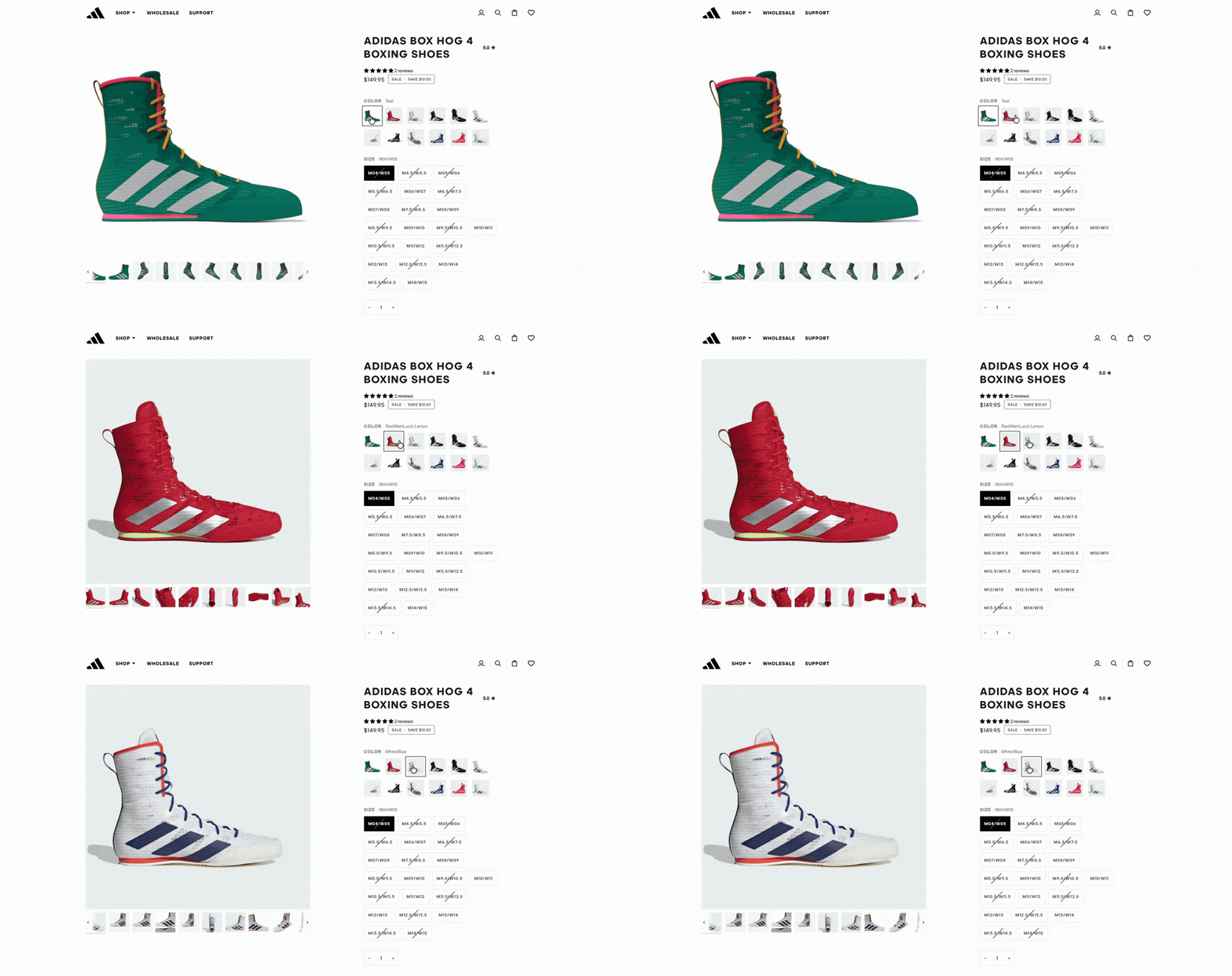
Variant consolidation on PDPs. Previously, each color and size of a product lived as a separate listing. A shopper looking for the Box Hog 2 might click through 15 different product detail pages just to compare colorways. We consolidated those into single PDPs with proper variant selectors. The shopping experience is now one page per product, with options laid out cleanly.


Product description cleanup. Short and long product descriptions weren’t mapped correctly across all SKUs. We worked through the catalog systematically, ensuring descriptions are accurate, scannable, and SEO-friendly. This content has to do double duty for both shoppers and search engines.

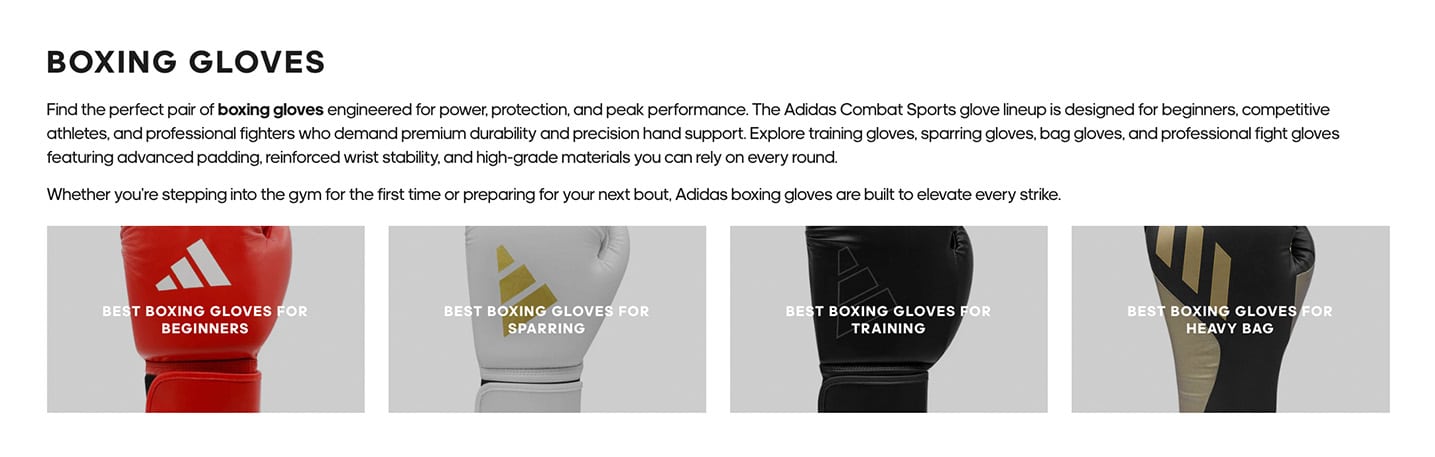
Collection pages built around buyer intent. The boxing gloves collection page now leads with intent-driven callouts at the top, like Best for amateurs and Best for sparring, that helps shoppers self-segment toward the right product faster. Variant indicators on collection cards allow shoppers to see available colors before they even click into a PDP.


These may not be the glamorous changes that get highlighted to executives, they are the kind of UX hygiene that, in aggregate, separates a site that ranks well from a site that also converts traffic. In the one quarter, we saw a lift in key event rate and an 18% jump in events per session. Both are signals that shoppers are more engaged on the site.

Email & Owned: A Quiet Layer Doing Necessary Work

Email doesn’t carry the headline number, but it’s earning its place in the program.

Our strategic priorities for the email program include list growth and segmentation. The list is still small relative to site traffic. Our subscription offer and welcome flow are growing that list, with abandoned shopper flows accountable for securing those who don’t convert, and campaigns assisting with customer retention.

As part of our segmentation strategy, we’re tagging subscribers by the sport they show interest in. As Adidas Combat Sports expands into new categories within boxing, taekwondo, karate, and beyond, we’re building the foundation to segment emails to high-intent, sport-relevant lists.

Results

Headline metrics, Q1 2026 vs. Q1 2025:

  • Revenue: +138% YoY

  • Purchases: +186% YoY

  • New customers: +180% YoY

  • Sessions: +157% YoY

  • Active users: +206% YoY


Channel-level highlights:

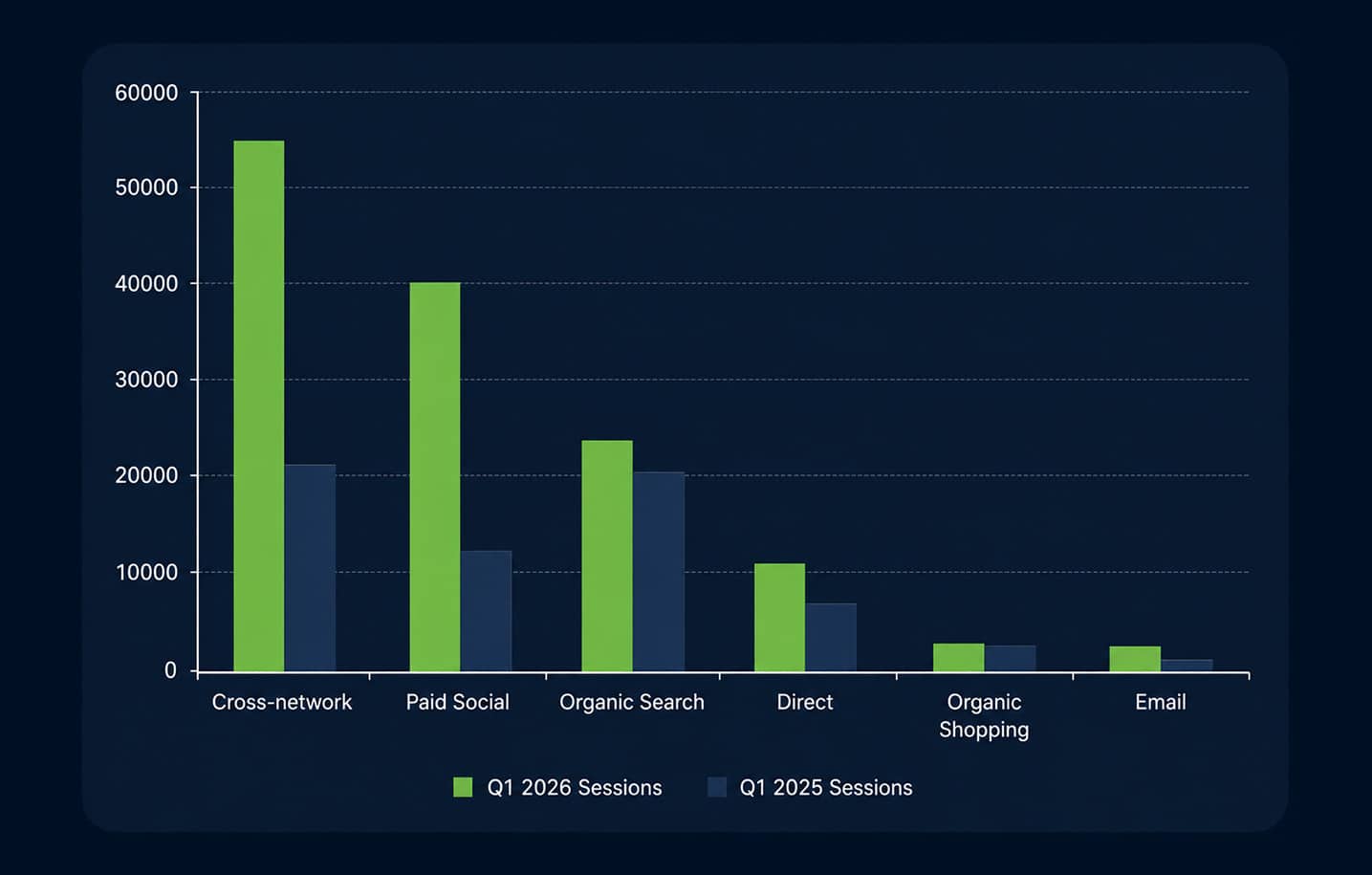
  • Cross-network Google sessions: +163% YoY

  • Paid Social: A net-new channel that didn’t exist in Q1 2025, now driving 26% of site traffic

  • Organic search revenue: +44% YoY

  • Paid media share of total sessions: 68%, up from 38% the prior year


In addition to the positive trends in KPIs, in a fast-growth, acquisition-first strategy, there are commonly metrics that drop. For Adidas, revenue per user dipped year-over-year as the program acquired new customers. That was an expected and accepted decision to scale top-of-funnel acquisition where many shoppers are first-time visitors. The next phase of work is designed to tighten that ratio without slowing growth.

Key Takeaways

A few principles other ecommerce teams operating at scale can take from this work:

  1. Strategy precedes optimization. The single biggest unlock for Google Ads wasn’t a bidding change. It was a strategic pricing recommendation. The first question on a stalled channel isn’t always “what do we change inside the account?” It should sometimes be “what’s true outside the account that’s making it hard to win?”
  2. Brand context dictates channel role. Channel role isn’t a one-size-fits-all model. For Adidas Combat Sports, they face the benefit and challenge of being under the Adidas parent brand. This necessitates playing the acquisition game differently than a brand with strong direct loyalty. That reality drives channel decision in this program, including leaning into branded search.
  3. CRO is leverage on paid media. For Adidas, it isn’t paid media or CRO. It’s both, with a multiplier effect, because they are working for the same goal. Variant consolidation and intent-driven collection pages aren’t standalone wins. They’re one part of what makes the paid spend work as hard as it does.
  4. One agency, one strategy. Adidas’ decision to work with a single agency across digital channels is producing outsized growth. LimeLight runs Meta, Google, email and the website as a cohesive program, with channels working together under a single strategy.


As Kyle describes it:

“When you have it all together, the channels communicate with each other, and there’s someone orchestrating the entire strategy, that’s where you get the best payout from a store growth standpoint.”

For Adidas Combat Sports, every channel is rowing in the same direction: acquire new customers, profitability, at the efficiency target the client has set. Meta hands off to email. Google’s pricing insight shaped the broader merchandising conversation. Website improvements are prioritized based on where paid traffic is landing. That coordination doesn’t happen by accident, and it’s hard to replicate across multiple agency partners. It’s the actual product LimeLight delivers, and it’s why the performance metrics look the way they do.

More Case Studies

Adidas Combat Sports

How a Unified, Acquisition-First Strategy More Than Doubled Revenue Year-Over-Year

Step2

CRO program projects $500K+ annual revenue lift for North America’s largest toy manufacturer

Sunnyland Farms

A legacy brand embraces modern commerce

Adidas Combat Sports

Shopify migration drives 127% revenue lift for Black Friday

Cane River Pecan Company

Legacy gifting brand modernizes ecommerce experience

Knix

Analytics migration powers data-driven growth for leading intimates brand

Martin Dingman

Record-breaking Black Friday sales for luxury brand

Pitsco

Shopify website boosts growth for a leader in education

Zest Desk + BigCommerce

Enhancing phone order efficiency and accuracy for support teams

Martin Dingman

A step forward in refined leather goods

Backyard Discovery

Shopify redesign drives 125% revenue growth

Creative Candles

E-commerce Optimization & Revenue Growth

LED Esthetics

Email marketing lights up skin care brand

Backyard Discovery

Streamline and scale expanded content with Salsify

Step2

Centralize and steamline product data with Salsify

Southern Tire Mart

A new website for the extra mile

Backyard Discovery

New product launch: Just Add Gardener

Arduino Education

Createchivity campaign drives brand awareness

Paul Mueller Company

Beer Genius taps into a new website

Backyard Discovery

5,000% growth through email marketing

KEY Apparel

Digital transformation for historic apparel brand

Creative Candles

Handcrafting luxury experiences

Colorado Golf & Turf

Hole in one website redesign

Russell Cellular

OEM media campaigns for Verizon retailer

Lenexa Manufacturing Company

Videos assist high ticket sales

Ready for better ecommerce?

Your business deserves infrastructure that supports its ambitions.