
Google AI Is Changing Ecommerce: When Search Becomes the Checkout
Google just announced a new wave of technology designed to help retailers to compete in what it’s calling an agentic shopping era.
For ecommerce brands, this isn’t just another product update. It confirms the fundamental shift in how shoppers discover, evaluate, and purchase products online.
For years, ecommerce strategy followed a predictable path: search traffic brought shoppers to a website, product pages did the selling, and checkout completed the transaction.
That model is changing—again.
Google’s latest AI developments show that AI is no longer limited to answering product questions. It is increasingly recommending products, comparing options, and enabling purchases directly inside AI-driven experiences.
For ecommerce leaders, this marks a new era of AI-driven ecommerce strategy, where discovery, consideration, and checkout are no longer confined to a traditional website flow.
How Google AI Is Transforming the Ecommerce Shopping Experience
Google is rapidly evolving from a traditional search engine into an AI-powered shopping platform.
With conversational search powered by Gemini, AI-generated product recommendations, and emerging checkout experiences inside AI interfaces, shoppers are beginning their buying journey in entirely new ways.
This shift is often referred to as conversational commerce, and it fundamentally changes how brands show up, influence decisions, and convert demand.
The Traditional Ecommerce Funnel (Before AI-Driven Commerce)
Before AI-driven shopping experiences, ecommerce journeys were linear and brand-controlled.
Search results sent users to a website homepage, then to a product detail page, followed by the shopping cart and checkout. Brands controlled discovery, messaging, conversion optimization, and the checkout experience.
SEO, paid search, and conversion rate optimization were the primary levers for growth.
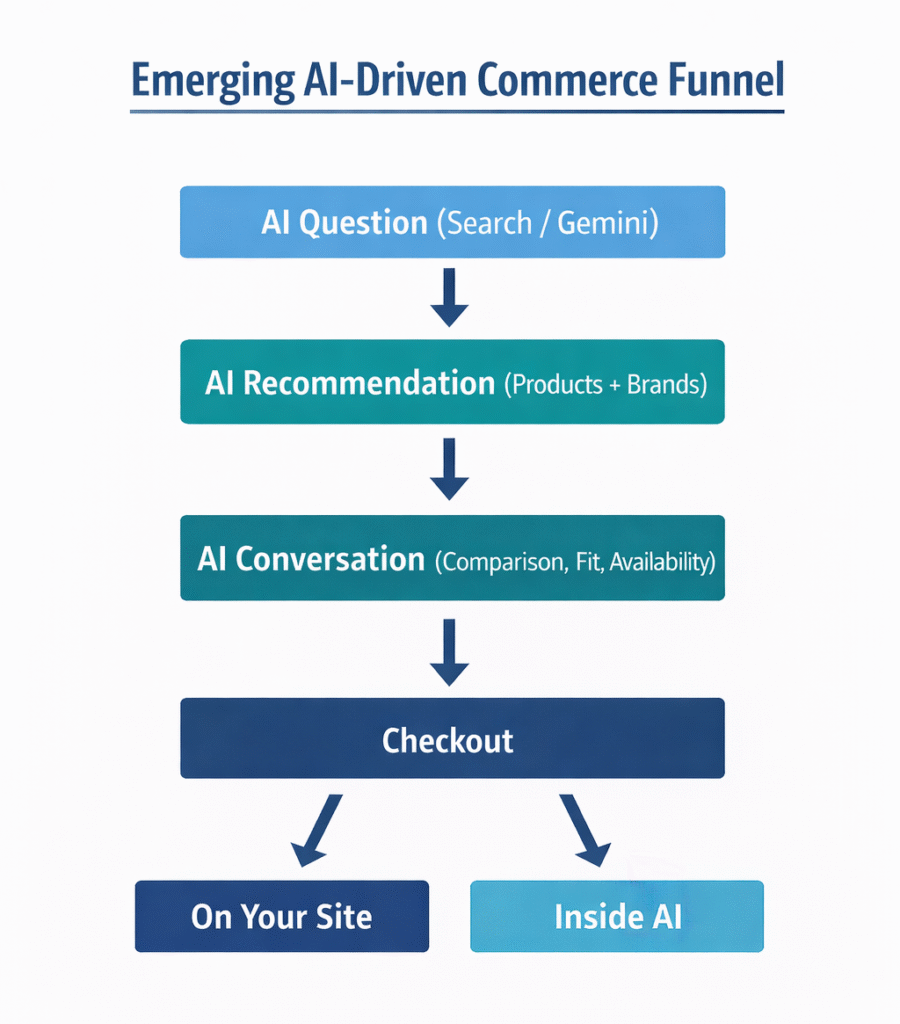
The Emerging AI-Driven Commerce Funnel Powered by Google AI
AI disrupts that linear model.
Instead of sending users directly to websites, AI increasingly acts as the guide throughout the shopping journey, surfacing products, answering questions, and facilitating purchases.
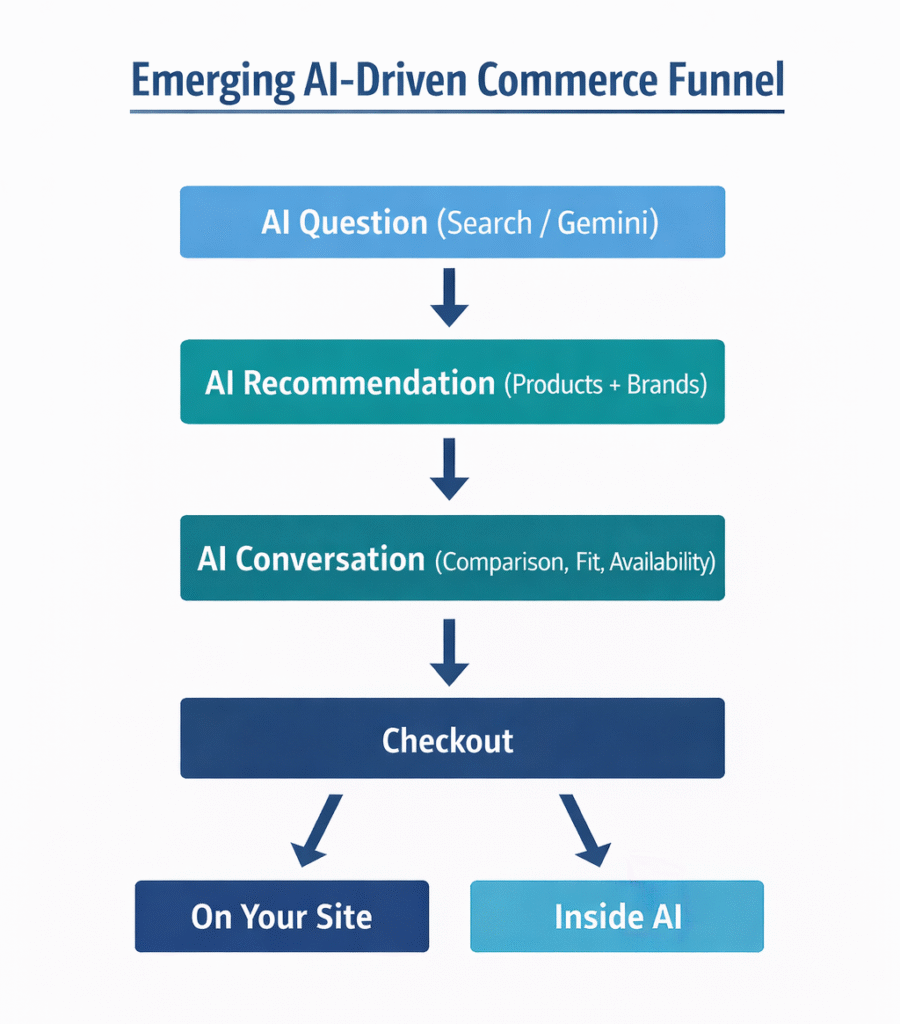
In this new funnel:
- AI handles discovery and initial consideration
- Product comparisons happen inside conversations
- Checkout can occur either on a brand’s website or directly inside AI
- Product data and brand clarity power the experience
This is the reality of AI ecommerce.
Why Product Data Is the Foundation of AI-Driven Ecommerce
In an AI-powered shopping experience, product data becomes the most important ranking and eligibility signal.
When AI determines:
- Which products to recommend
- How to explain differences between brands
- Whether a product is available to purchase
…it relies on structured, accurate, and complete product information.
Brands with inconsistent pricing, incomplete attributes, weak product descriptions, or poor data hygiene risk disappearing from AI-driven shopping experiences entirely.
AI does not infer missing details—it moves on.
How Conversational Commerce Is Changing Paid Search and Shopping Ads
This month, Google announced it is expanding paid placements within AI-driven search experiences, including shopping ads that appear inside AI responses.
This introduces new performance dynamics:
- Fewer traditional clicks for certain queries
- More emphasis on visibility and influence
- Changing expectations around attribution and conversion paths
Winning in AI search ecommerce is no longer just about bids and keywords. Eligibility, relevance, clarity, and product data accuracy are becoming equally important.
How Ecommerce Brands Should Prepare for Google AI Shopping
AI-driven commerce is not a future-state concept. It’s an immediate readiness issue.
Optimize Product Data for AI Shopping Experiences
Brands should prioritize clean product feeds, complete attributes, consistent pricing, and accurate inventory data that AI can reliably interpret.
Make Your Brand Ready for Conversational Commerce
Clear product-level messaging, strong value propositions, and customer-friendly policies help AI confidently represent your brand during conversations.
Redefine the Role of Your Ecommerce Website
Websites increasingly act as trust validators, not always the first touchpoint. Reviews, social proof, and frictionless checkout become critical when shoppers arrive late in the journey.
Rethink Measurement for AI-Driven Search and Checkout
As AI mediates more interactions, brands must adjust how they measure performance—accounting for assisted conversions, visibility, and influence across AI surfaces.
What Google AI Means for the Future of Ecommerce Strategy
Google is no longer experimenting with AI in ecommerce; it is operationalizing it.
The brands that succeed will not be those chasing every new tool. They will be the ones with:
- Clean, structured product data
- Clear brand positioning
- Strong ecommerce fundamentals AI can understand and trust
AI does not replace ecommerce fundamentals.
It exposes them.