

If you’ve ever sat in a budget planning meeting where someone used “CRO” and “UX” interchangeably, you’re not alone. Most marketing teams blur these two disciplines together, treating them as different names for the same thing. They’re not, and understanding the distinction could be the difference between marginal gains and meaningful revenue growth.
Conversion rate optimization (CRO) focuses on conversion performance, getting more visitors to take the actions that drive revenue.
User experience (UX) optimization focuses on friction reduction and the overall perceived experience of using your site.
Both matter. But they drive impact at different stages of the customer journey and deserve different levels of investment depending on where your site stands today.
As marketing budgets face increased scrutiny, leaders need clarity on where optimization dollars will deliver the strongest returns. This guide breaks down the real differences between CRO and UX, when to prioritize each, and how to allocate your budget for maximum conversion impact.
Defining the Difference: CRO vs. UX Optimization
Before we talk about where to invest, let’s establish what each discipline actually does.
What CRO Does
Conversion rate optimization is focused on increasing meaningful actions, like demo requests, signups, quote submissions, and purchases. CRO practitioners use A/B testing, funnel analysis, behavioral insights, and messaging clarity to identify what persuades visitors to convert. The discipline is inherently performance-driven: every test has a measurable outcome tied to a business metric.
A typical CRO engagement with LimeLight Marketing commonly involves testing different headline variations on a landing page, optimizing form fields to reduce abandonment, refining CTA copy and placement, or restructuring product pages to address common objections.
The goal is always the same: move the needle on conversion rates.
What UX Optimization Does
User experience optimization focuses on usability, clarity, navigation, and the overall experience of interacting with your site. UX practitioners use audits, heatmaps, user testing, accessibility checks, and information architecture improvements to ensure visitors can accomplish what they came to do without frustration.
A UX engagement might involve reorganizing navigation to reduce confusion, improving mobile responsiveness, ensuring accessibility compliance, streamlining multi-step processes, or addressing page load speed issues.
The focus is on removing obstacles and creating a smoother path through the site.
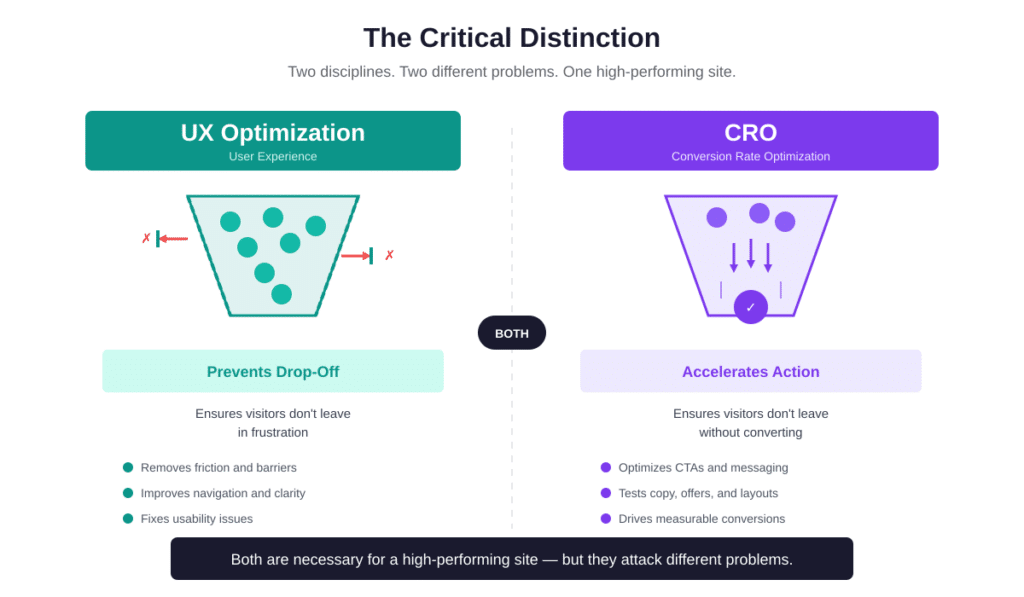
The Critical Distinction
Here’s the simplest way to think about it:
- Strong UX prevents drop-off
- Strong CRO accelerates action
- UX ensures visitors don’t leave in frustration
- CRO ensures they don’t leave without converting
Both are necessary for a high-performing site, but they attack different problems.
What Drives Bigger Conversion Gains?
When marketing leaders ask which delivers more impact, the honest answer is CRO, with an important caveat.
CRO directly influences revenue-driving metrics. Testing copy, offers, form structures, CTAs, and page layouts can unlock substantial conversion gains because these elements directly affect visitor decision-making.
A headline that better addresses visitor objections, a CTA that creates more urgency, or a form that reduces perceived commitment. These are the levers that move conversion rates by meaningful percentages.
UX optimization, by contrast, tends to deliver incremental improvements after major usability issues are fixed. Once your site is navigable, loads quickly, and works on mobile, additional UX refinements produce diminishing returns.
The biggest UX gains come from fixing what’s broken, not from polishing what already works.
That said, the data consistently shows the biggest wins occur when CRO and UX work together. CRO identifies where visitors are dropping off and what might persuade them to convert. UX ensures the path to conversion is clear and frictionless. But when it comes to driving measurable lift, CRO takes the lead.
Step2, North America’s largest toy manufacturer, was stuck at a low conversion rate, and traditional promotions weren’t moving the needle. LimeLight’s CRO program delivered an 86% lift in search conversion, a 34% increase in add-to-cart rate, and over $500K in projected annual revenue impact. Read the full case study here.
Where UX Wins: Fixing Hidden Friction That Kills Conversions
None of this is to say UX doesn’t matter. In fact, there are specific scenarios where UX issues are actively killing conversions and no amount of CRO testing will help until they’re addressed.
Navigation clarity is often the biggest culprit. If visitors can’t find what they’re looking for within seconds, they leave. A confusing menu structure or buried product pages can reduce conversions even when the CTA on those pages is perfectly optimized. You can’t convert visitors who never reach your conversion points.
Mobile usability continues to be a conversion killer for many B2B sites. Decision-makers increasingly browse on mobile, and sites that don’t render properly or require excessive pinching and scrolling lose potential customers before any conversion optimization can take effect.
Accessibility issues create barriers for a meaningful percentage of your audience. Beyond compliance requirements, poor accessibility means lost conversions from visitors who simply can’t interact with your site effectively.
Form design sits at the intersection of UX and CRO, but fundamental usability issues (fields that don’t work on mobile, unclear error messages, or forms that lose data on submission errors) are UX problems that must be fixed before CRO testing makes sense.
Page load speed affects both UX and SEO. Sites that take more than three seconds to load see significantly higher bounce rates, and no landing page optimization can overcome visitors who leave before the page renders.
The bottom line: UX removes barriers. CRO amplifies what works. If barriers exist, they need to be removed first.
The 2026 Outlook: Why CRO Will Drive More Budget Allocation
Several trends suggest CRO will capture a larger share of optimization budgets in 2026.
Markets are tightening, and marketing teams face increased pressure to demonstrate measurable ROI. CRO directly ties to pipeline and revenue metrics in ways that are easy to communicate to executive leadership. When budgets face scrutiny, initiatives with clear attribution to revenue outcomes tend to survive.
AI-driven testing is making CRO faster and more cost-efficient than in previous years. Machine learning algorithms can now identify winning variations more quickly, run multivariate tests that would have been prohibitively complex, and personalize experiences at scale. The cost-to-impact ratio for CRO has improved significantly.
Meanwhile, UX optimization will shift more toward maintenance mode for many organizations. Sites that have undergone recent website redesigns or addressed foundational usability issues don’t require the same level of ongoing UX investment. The discipline remains essential, but the budget allocation often moves toward periodic audits and refinements rather than major initiatives, unless the site has foundational problems that need addressing.
When to Prioritize UX Over CRO
Despite the case for CRO, there are clear situations where UX investment should come first.
Prioritize UX if…
- …your site is visually outdated or difficult to navigate. First impressions matter, and a site that looks like it was built in 2015 undermines credibility before visitors ever reach a conversion point.
- …engagement metrics show clear friction. High bounce rates, low time on page, or poor scroll depth on key pages suggest visitors are struggling with the experience itself, not just the persuasive elements.
- …mobile performance is weak. Check your analytics: if mobile traffic is significant but mobile conversions lag far behind desktop, you likely have a mobile UX problem that needs solving.
- …you’re planning a redesign in the next six to twelve months. CRO testing on a site that’s about to change is largely wasted effort. Focus on UX and information architecture work that will inform the redesign, then shift to CRO once the new site launches.
If your site has many UX issues, it’s likely time for a website redesign.
Prioritize UX if your CMS or layout system limits testing. If you can’t easily make changes to test different variations, investing in CRO tools and programs won’t deliver results. Fix the underlying platform constraints first.
If any of these conditions apply, UX should come before CRO.
When to Prioritize CRO Over UX
On the other hand, CRO should lead if certain conditions are already in place.
Prioritize CRO if…
- …your site already looks and feels modern. If the visual design and overall experience are solid, incremental UX improvements will yield less than focused conversion testing.
- …the user journey is clear. When visitors can easily find what they need and navigate to conversion points, the opportunity lies in optimizing those conversion points themselves.
- …traffic volume is strong but conversions are flat. This pattern suggests visitors are finding your site and engaging with it, but something in the conversion experience isn’t working. That’s a CRO problem.
- …marketing is scaling paid traffic or ABM initiatives. When you’re actively investing in driving more visitors to your site, the ROI on converting a higher percentage of those visitors compounds quickly.
- …you’re under pressure to prove pipeline gains in 2026. CRO delivers measurable, attributable results that can be tied directly to revenue outcomes, exactly what leadership wants to see.
If growth is the primary goal, CRO typically comes first.
Budget Recommendation: How to Allocate Spend in 2026
Based on these principles, here’s how to think about optimization budget allocation.
For most companies with structurally solid sites: allocate roughly 60% to CRO and 40% to UX. This balance allows for ongoing conversion testing while maintaining UX quality and addressing issues as they emerge.
For companies with major usability issues: flip the ratio initially, 70% UX, 30% CRO, while you address foundational problems. Once those are resolved, shift to 70% CRO, 30% UX to capitalize on the improved experience.
For companies planning a redesign: invest heavily in UX and information architecture upfront. This work should inform the redesign and ensure the new site is built on solid usability foundations. CRO becomes an ongoing discipline post-launch, where it can drive continuous improvement on the new platform.
The Ideal Approach: CRO and UX Working Together
The most sophisticated optimization programs don’t treat CRO and UX as separate initiatives competing for budget. They work as a continuous cycle.
CRO testing identifies where visitors are experiencing friction or failing to convert. UX research and optimization solves the underlying experience issues. CRO then validates that the solutions work through testing. The cycle repeats, creating compounding conversion improvements over time.
This integrated approach requires both disciplines to share data and insights. Heatmaps and session recordings from UX tools inform CRO hypotheses. A/B test results from CRO programs reveal UX issues that testing alone can’t solve. The two practices make each other stronger.
Your 2026 Conversions Depend on Choosing the Right Priority
CRO moves the needle fastest when the foundational experience is solid. UX ensures long-term user satisfaction and prevents the friction that kills conversions before they happen. The right balance between them depends on your current traffic quality, website maturity, and growth objectives.
The worst approach is to blur them together or assume one can substitute for the other. They solve different problems and require different expertise. Understanding that distinction is the first step toward smarter optimization investment.
As you build your 2026 budget, take an honest look at where your site stands. If usability issues are holding you back, address them first. If your site is solid but conversions are stalling, CRO offers the clearest path to measurable gains. And if you’re not sure which applies, that’s where a proper assessment comes in.
If you’re building your 2026 optimization roadmap, we can help you evaluate where CRO or UX can unlock the most revenue for your specific situation. Contact us to start a conversation with a UX specialist.